
What is "The King of Ratings", you ask?

"The King of Ratings" takes and exaggerates common methods used in the media to help gain popularity and help with advertising of, for example, a product. The comedians in this skit take things like typical soap-opera plot lines, idols actors, PPLs (product placements), and other cliches that, no matter how obvious and ridiculous they are, still bring in high viewer ratings.

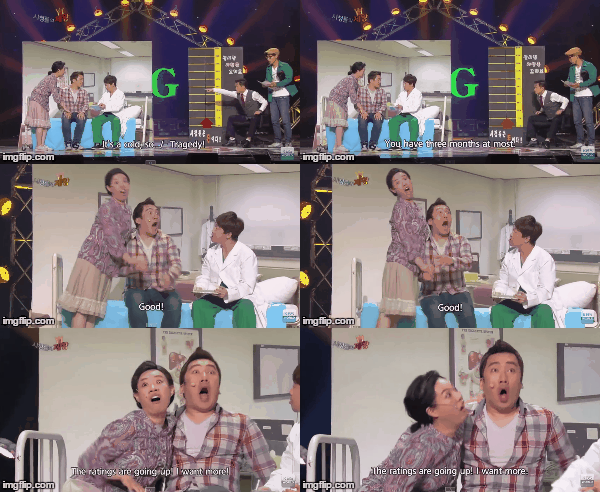
In this particular episode of Gag Concert, "The King of Ratings" starts off as it normally does, with Director Park, played by Park Seonggwang, scolding one of his directors for bringing in low viewer ratings. Park names himself the "King of Ratings", and his main goal is to bring in the highest viewer ratings as possible no matter how they do it, even insisting on the awkward insertion of a PPL. This time, the setting is in a hospital, with the drama named "White Tower", which is similar to another real Korean drama, Behind the White Tower. (In each episode, this skit takes a drama name and puts a spin on it, which makes it more relatable to those who recognize the original, and as a result, more likely to continue watching this skit.) A patient comes in, who is diagnosed with a cold by the doctor. As the comedians act out "White Tower", Producer Park continuously complains about the viewer ratings. As the scene progresses, Park puts a twist on it, turning the patient's cold into something that will only allow him to live for three months.
These kinds of plot twists are so common in dramas nowadays in order to, for example, instigate conflict between certain characters or to extend a show that really should just be ended. Producers also may insert a scene where it acts as a catalyst for the protagonist to get what he/she wants. There's the typical "love interest gets hit by a car", for example. In this, the love interest is close to death, perhaps in a coma, which makes the other main character finally realize his/her true feelings. Or, there's the typical "main character gets amnesia" arc. The amnesia arc is very cliche in Korean dramas, and many people like to poke fun at it. It is put in to help move the plot along. These types of plot twists typically make viewer ratings go higher because the audience wants to know what's going to happen to the characters that they've grown so attached to.
These kinds of plot twists are so common in dramas nowadays in order to, for example, instigate conflict between certain characters or to extend a show that really should just be ended. Producers also may insert a scene where it acts as a catalyst for the protagonist to get what he/she wants. There's the typical "love interest gets hit by a car", for example. In this, the love interest is close to death, perhaps in a coma, which makes the other main character finally realize his/her true feelings. Or, there's the typical "main character gets amnesia" arc. The amnesia arc is very cliche in Korean dramas, and many people like to poke fun at it. It is put in to help move the plot along. These types of plot twists typically make viewer ratings go higher because the audience wants to know what's going to happen to the characters that they've grown so attached to.
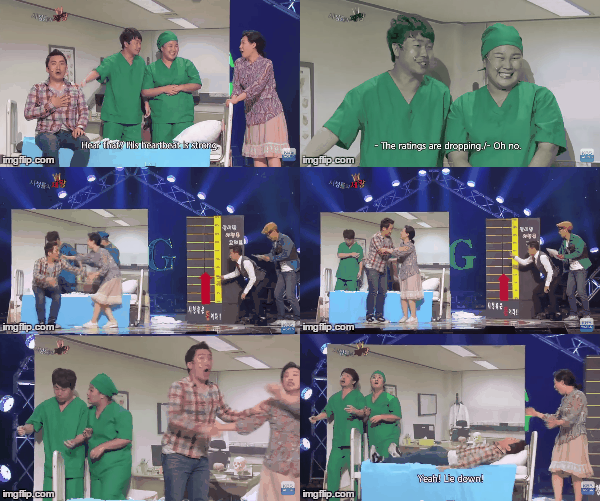
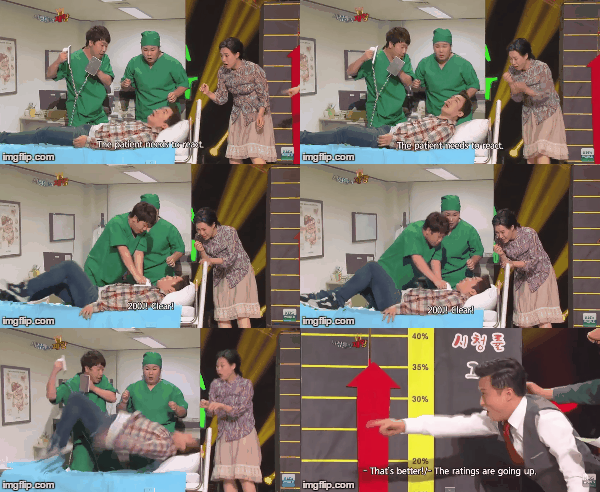
They soon have to "operate" on the patient, but the doctor and intern who are residing over this patient end up being too nervous to operate to a comedic extent. They skip the operation scene because Producer Park wills it, and the patient is perfectly fine now. But, of course, we can't allow the viewer ratings to drop, can we? The patient suddenly is in an emergency state, and the doctors use a defibrillator.
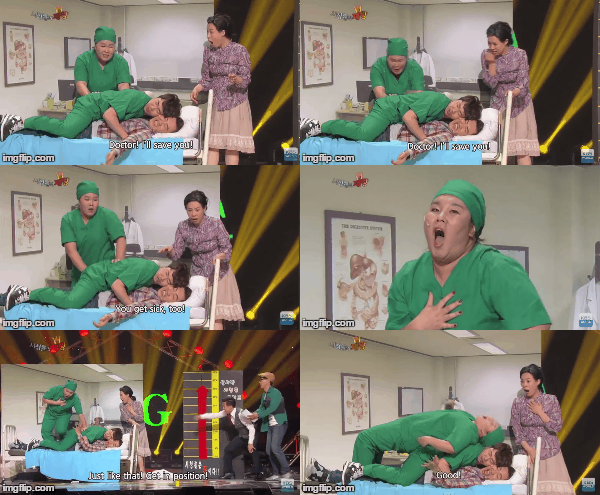
The doctor says he wont give up on saving the patient, and he sits on him. Then, he suddenly get sick as well and falls on top of him. The intern, who is a comedian known for skits centering around her weight, tries to save the doctor, but then "falls" on top of the other two as well.
Producer Park later brings in another doctor: the good looking idol doctor, played by comedian Ryu Geun Ji. This is the typical idol star who is put in a drama despite his/her extremely bad acting. Even if those idols are completely horrible at acting, some directors and producers keep them to keep ratings up. Ratings shoot up, and Ryu purposefully acts out exaggerated bad acting. He recites the instructions, "Open parenthesis. Walk. Step. Step. Close parenthesis", which makes it all the more funnier, emphasizing the horrible acting of idol stars. (Of course, not all idol stars are horrible actors/actresses.) This brings up a strategy commonly used in real life. In order to profit, some may do whatever they can to achieve this, and will take advantage of someone or something. In this case, directors take advantage of the idol's popularity to gain higher viewer ratings in order to appeal to a large group of fans who would probably watch a whole drama just to see their bias. Fanatic fans wouldn't actually care if their bias's acting was bad--they probably would protect their bias to the ends of the earth. This is what directors feed off of in order to gain profit.
Everything's messed up now because of the idol doctor's horrible acting. Now what? Oh, okay, we'll just make this all a dream! (Producers might insert a plot twist like this in order to abruptly end a drama.) Then comes the absurd PPL.


Of course, real PPLs aren't like this in the movies and shows we watch today. (At least I haven't noticed any this painfully obvious.) In this skit, everything is exaggerated, and it lets us have a good laugh about it. But a lot of the time, we see many products being used by a character, or a product lovemark in the background somewhere. What exactly are they trying to tell us? "Go to this place and buy this stuff because you see your favorite characters trying these things out, and they're so happy with it, so you will be as well!"
"The King of Ratings" makes fun of all of the elements used by producers in their dramas. Each part is exaggerated, from colds being a deadly illness to a hiking boot in a stomach during an operation, which makes it even better to watch. This exaggerated, comedic style not only parodies those elements used, but it also makes us stay and continue watching, because these absurd aspects stand out to us and we want to know everything that comes next.
I definitely would recommend this (actually, I would probably recommend most of the Gag Concert skits). I think they're all very entertaining, and it definitely makes me laugh. The ideas that the comedians come up with are just pure gold (of course, I'm probably just completely biased). Of course, a handful of the jokes that the comedians come up with are definitely jokes that would only make sense if you were born in Korea and were used to their culture (it probably would help if you actually knew the language as well). But I believe that many of the skits would be appealing to many of us. Or, I'm just so used to their sense of humor that I'm the only one that thinks this is funny.
If you want to watch it (you really should), here's the link:
https://www.youtube.com/watch?v=f8bsGHKJQDA

No comments:
Post a Comment