Greetings and salutations, fellow human beings. Welcome to Cherplestantinople, where you are subjected to the weekly updated posts composed of the analyses of the media around us.
Today is the day that I finally retire from my media blog. When I first started this blog, it was merely a homework assignment that I had to fulfill the requirements for in order to get full credit. I freaked out over what to talk about because I thought there would have been nothing to talk about. But unexpectedly, I found it quite effortless and painless to find things to discuss. (Of course, they were all things that interested me--mainly Korean-related things.)
Thanks to the horrible memory I have, I honestly cannot remember how I interacted with media before I started this blog. I believe I can confidently say that the amount of time I spend with exposure to media has not changed--however, my behavior and attitudes towards the pieces of media I see have definitely changed a lot. There has not been one day that I have not gone without analyzing a certain piece of media. I find myself approaching any advertisements with both skepticism and cynicism. Now that I know a little about how the media works, I can't help but behave this way. I just end up blurting out random advertising techniques at different commercials when I recognize them.
There is a great reward in being educated in the world of media. Because I have learned so much about the inner workings of media, I can understand all the assumptions, values, connotations, etc., that form the culture of the source of media. By knowing all the different techniques that advertisers use, we can actually properly comprehend everything they are saying about us as a society under the surface. Many of the words and stories that are delivered through media have been manipulated, and so through this, our minds can be easily controlled. The real thing is never portrayed accurately.
Now, I see all the subliminal messages that companies are brainwashing our minds with. Every advertisement, every marketing campaign has an ulterior motive. Advertisers condition our minds with all these implicit messages. We're never good enough, or strong enough, or successful enough, or pretty enough. Our lives are boring. They have to be exciting. Be adventurous. Take risks. Even if we give in to an advertisement in an attempt to become that perfect person, there will always be the next advertisement that brings you back down. The vicious cycle begins once again.
With my departing from this blog, I would have expected to feel some sort of emotion that verged on sentimentality. But I honestly don't feel much of anything. Perhaps it just hasn't hit me yet, or perhaps this blog truly was just another assignment for me. But regardless of what the blog itself meant to me, I truly have learned a lot throughout the time period of my Critical Thinking course. Despite all of this, I don't think I ever would have the time and dedication towards such a project. But what I will continue to do is to regularly use the knowledge that I have gained from my zero period in daily life in order to have a solid awareness of the motives behind advertising campaigns and the implicit messages that come with them. I know I can never escape the shackles that media has placed on us consumers. So many advertisements have been presented to us, each new advertisement created with the intent of breaking through the clutter. I can't control what is exposed to me. But what I do have control over is how I react to these advertisements. With active awareness of what is being exposed to us, we have the power to make the media not as strong as it can be. We don't have to let this external force determine what we are.
Lately, with all the stress that has built up from school (just because summer's almost here doesn't mean I'm not stressed), I've been in this "Disney mood". I just needed a break from everything, so I decided to go watch Mulan and have this blog post be my excuse for slacking off.
Mulan would have to be one of my favorite Disney movies, mainly because it somewhat promotes feminism and shows an individual woman breaking through the stereotypes and expectations of what a woman is 'supposed' to be like. Mulan isn't the damsel in distress--she's the one kicking everyone's butt, saving a whole nation in the process (also saving her love interest).
Throughout the movie, there are many stereotypes that are delivered to us. In the beginning of the movie, Mulan has to pretend to be the perfect bride. She has to constantly act out the expectations of gender roles that have been formed by her society. She has to remind herself to act a certain way, even writing reminders on her arm. In "Reflection", she describes her troubles with her identity, mentioning how she'll never be a perfect bride nor daughter. She no longer recognizes herself because she has to force herself to change the way she looks and the way she acts in order to appease the expectations that others have for her. There's a big conflict that is delivered here: Mulan has to solve the conflict between being herself and being someone who society and her family wants her to be. When she joins the army later, she even has to change herself to fit in the stereotypes of the male gender role. Also, when the Huns invade China, one man from each family was required to serve in the army. This was an honorable action. Gender roles are reinforced with how the man of the family was to fight for his country, leaving the women at home to take care of the family and be a good homemaker. They are confined to domestic affairs. This suggests that the home is their place in their society. This is also still a pretty prominent stereotype in our current society. But Mulan attempts to break out of this expectation.
In the song where the army that Mulan is serving in, Ling, Yao, and Chien-Po talk about their ideal woman. Respectively, they want a woman "paler than the moon with eyes that shine like stars", one who would "marvel at [his] strength, adore [his] battle scars", and one who believes a woman's worth "depends on what she cooks like". Apparently, the ideal image of a woman is one who looks beautiful, one who is able to reinforce a man's ego, and one who is able to cook well. Mulan tries to go against what her fellow soldiers say and sings a line that is an unorthodox quality of women in their society. They obviously don't agree with what she says a woman should be like. Also, the repeated lyric "A girl worth fighting for" objectifies women, implying that only women with certain traits are worth fighting to the death for. Others just aren't important.
Yes, Mulan breaks out of gender role expectations, but it's quite unpleasant to see that the only way she could prove herself to her family and redeem her honor (i am reminded of zuko suddenly) was to dress up like a man. In a way, this film can be very empowering, but it can also be quite detrimental to the advancement of equality for women because of all the stereotypical scenes the movie has. Despite this, I still like that Mulan was able to do what she did. When she won, she was in female clothing. This immediately reminded me of the 'Atonement" step of the Hero's Journey. In the end, I suppose that she becomes comfortable with being 'just' a female. Whether or not she's wearing male clothing, she's still the same powerful person who saved a whole nation. (From what I remember, I can't say I liked the second Mulan movie very much because she's subjected to a forced marriage where any trace of female empowerment is scrapped.)
This is a commercial that I saw a while ago but would like to talk about in this blog post.
The commercial shows two successful people, one female and one male, in identical situations but labeled differently from each other. A man giving a speech is known to be persuasive, but when the woman does the same thing, she is labeled as 'pushy'. A man is a boss, but a woman is 'bossy' (which reminds me of the female arcetype 'bitchy boss'). A man who works late into the night is someone who is dedicated, but a woman who does the exact same thing is selfish. A man who takes care of his own appearance is neat, but a woman who takes care of her appearance is vain.
It calls attention to the gender double standard that is prominent in our society, as well as social gender stereotypes. There is a big difference in how men and women are perceived in the workplace. Men's actions are often seen in a positive light, and the words associated with describing them are often positively connotative. Women's actions, on the other hand, are often viewed negatively.
As you watch it, you may forget that this video was an advertisement in the first place. The feminist message that Pantene sends just helps with the advertising even though it has nothing at all to do with Pantene products. As the success of the commercial itself is increased, more product is sold.
There's a use of reification in this commercial. Pantene is telling us that we should be strong by "shining". It doesn't refer to us living our lives the best we can and being confident about everything, along with being empowered with our beautiful inner selves--rather, it's really just referring to hair. By buying a Pantene product, our hair will shine, and in turn, it will make us beautiful and confident. A woman portrayed in the video is seen, at the end of the video, happily walking across the street, with her shiny, beautiful hair. Pantene is telling us that aesthetics are essentially the most important aspects of ourselves. It sends the message that women won't be taken seriously enough unless we buy and use Pantene and have beautiful, shiny hair.
Today, I came across one of BuzzFeed's videos, where some of the BuzzFeed female cast members reacted to the waistlines of Disney princesses.
I thought about it, and I realized that I never really noticed that the princess had such tiny waists. And that's the scary thing--the fact that images like these have been engraved into our minds as normal, whether it be on a subconscious level or not. It's scary that each time I watched a Disney movie, each time I saw Jasmine or Ariel or Aurora or any other woman in Disney, I never even questioned any of their appearances. I just viewed whatever image I saw and never actually properly absorbed everything Disney was saying about women. We don't question it, and we just accept it as 'normal'. We shouldn't be accepting this, however. Disney doesn't care about us. Michael Eisner, a past CEO of Disney, has said, "We have no obligation to make art. We have no obligation to make a statement. To make money is our only objective." Disney doesn't care about how we take their messages. All that matters is that they make profit, whether it be from the degradation of our society as a whole or not.
Recently, my class and I watched Frontline's documentary MissRepresentation. It brought up several good points about how the media's portrayal of women has affected the outlook of women by society as a whole. By constantly feeding us women who are depicted as sexual objects in revealing clothing, the girls of our society feel this need to fulfill these expectations--the expectation that they must focus on perfecting their bodies instead of their minds. The media has often portrayed women constantly in skimpy, revealing clothing, with oversexualized behavior. Not only is this expectation of being a sexual object prominent in our society, but we start to become our own worst enemies and make ourselves feel that reaching the ideal standard of how a woman should look is an obligation that we must fulfill no matter what. So we start to focus on polishing how we look and how to become the 'perfect' female instead of focusing on our actual dreams and achieving great things in life.
Even if women are qualified in a certain field, they are subjected to criticism of their looks. Their achievements are not even taken into account, and they're immediately associated with negatively connotative words, like Hilary Clinton with "bitchy", "annoying", "too pushy", etc. There's a clear double standard here if we were to compare this to a male politician, whose news would probably be reporting on matters such as his stance on whatever issue is out there, compared to what a female politician is wearing and how bad or good she looks in it. Our patriarchal society is scared to have empowered women. Normally, power is held in the hands of men. This is what has been delivered to us for a long time, so this is what's normal. We accept this, but we shouldn't be. Without the presence of females in power, we will never have female leaders. We don't feel as if it is possible to be someone with any power at all, so we don't even try.
People are naturally self-conscious, constantly caring about what opinions others have of them. Many females I know constantly complain of this problem or that problem with their bodies. The thing is... no one has ever even brought up whatever imperfections many girls obsess over. This is the problem here. We've become so conscious of how other people view us that we nitpick at small details that we personally view as features that just aren't 'right'. And of course, I''m not exempt from this disease. We're our own worse critics. But the reality is is that many of the things we see as 'wrong' with our appearance has been sculpted by what media constantly feeds us. Women have this need to become the midriff of their worlds. The media is a powerful thing. It plants an idea in our mind, the idea that women exist solely for the purpose of becoming pretty and fitting in impossible standards. But this is most definitely not true, and not even just for women. More and more people have to realize that us human beings cannot just be summarized into one category (e.g. women have to be pretty, women cannot be smart, men have to be manly, etc.). Fortunately, I believe more and more people are becoming more aware of this problem.
This video is a favorite of mine that I discovered quite a long time ago. In this video, Jon Cozart, also known as "Paint" on YouTube, parodies several Disney movie princesses (Ariel from The Little Mermaid, Jasmine from Aladdin, Belle from Beauty and the Beast, and Pocahontas from Pocahontas). He takes their individual situations and incorporates them into the real world. He provides each of the stories an alternative ending and makes each princess come face to face with real world problems.
The first up is Ariel, the mermaid princess. Ariel is living in her perfect little sea world, but something is destroying her ecosystem: British Petroleum. Obviously, there is a large environmental crisis concerning BP's oil spill. The Little Mermaid has to deal with the fallout of it. Ironically, she is drowning in her very own natural habitat where she's supposed to be able to survive in the first place.
Next, Cozart gives us the point of view of Princes Jasmine. He pokes fun at the "war on terrorism", making Aladdin an alleged terrorist part of the Taliban who is unjustly interrogated by the "nation of the free". This brings up the problem with racist behaviors and thoughts towards Middle Easterners in general.
Then, we are greeted with a chorus of "a whore!"'s. Belle is criticized for marrying Adam, AKA the Beast, by the townspeople, and she has to face charges of bestiality. They accuse her of being a witch as well as Satan, and then it is sung that PETA was going to take the Beast away from her.
The fourth, and arguably the most enjoyable out of these four, featured Pocahontas and her experience after John Smith, her initial love interest in the movie, left her to go back to England. The problem with imperialism is discussed, especially focusing on the guns, germs, and steel brought to the New World by English, French, and Spaniards. Pocahontas has also learned to fight back against them, behaving like the "savages" Europeans made Native Americans out to be.
This song is definitely a clever way to both point out and criticize certain problems that are prominent in real life, as well as poke fun at what Disney movies are all about. The cliche "happily ever after"'s that are prominent in many Disney movies don't actually exist; hence the lyrics: "If you've ever wondered why / Disney tales all end in lies / Here's what happens after all their dreams came true", which starts off the song. There's a definite comedic element to this, which makes it all the more enjoyable.
If this was as brilliant for you as it was for me, Paint's "After Ever After 2", which features Mulan from Mulan, Cinderella from Cinderella, Tiana from The Prince and the Frog, and Elsa from Frozen, is just as impressive and won't disappoint.
Ever since the first time I listened to this song, I immediately took a liking to it. There were several reasons, of course. The first reason was because the song itself is very catchy, and the voices of the singers of the brother-sister duo Akdong Musician (AKMU), consisting of Lee Changhyuk and Lee Suhyun, are so addicting to listen to. The second reason was because of the deeper meaning behind the song (the video definitely helps with that). This message is directed towards everyone, really, but I think it is mainly focusing on teenagers.
In the beginning of the video, we see an older man looking out the windows, reflecting on his youth. He has a pet lizard, implying his personality is cold, as reptiles are cold-blooded. The camera pans to his drink with ice floating on the top. We see him as a young man, carrying a camera around with him.
The young man hitchhikes. But as the driver drives him, he takes pictures of the things in the backseat, and he kicks him out.
Next, the boy goes to a shop. The shop owner watches him carefully. As the boy pays for his things in change, the shop owner looks down with a cynical look. He stereotypes the boy as a thief, very distrusting of others.
We also see two parents arguing with each other, one Asian, and the other black. They represent the separation of races and how they don't get along with each other.The children beside them are innocent and don't see why they're arguing. They don't understand why they can't play with each other. The emotions of the arguing parents are imprinted onto their children, implying the loss of innocence.
The boy meets a lady prostitute who allows him to take pictures of her, but only after applying makeup. In general, prostitutes have to put on an act in order to gain a customer and make a living. She could symbolize the people who fake their personalities and lives in order to get what they want. She gives off the impression of a nice person, but in the end she just leaves the naive boy at a bar that she brings him to after finding a John.
She leaves him there with the unpaid bill and the bartender takes his anger out on the boy. He beats him up and ends up breaking his camera, which may symbolize the destruction of the boy's innocent dreams.
He goes to the police station to ask for help. They ignore him, however, because he seems unimportant. Everyone is busy, yelling at each other, absorbed in their own problems. They can't see the suffering of the other people around them.
He goes to the countryside and sees a dog. He attempts to befriend it, but the dog snaps at him and starts barking. This was his last hope and the last straw. Dogs are known to be "man's best friend", and because even the dog refused to show kindness towards the boy, he is shocked and starts "barking" back. He no longer sees the good in the world as he loses the lingering hope of good in the world around him. He turns into a beast, just like the dog, and pushes everyone around him away from him.
The camera the boy has also acts as a lens in which you can clearly see the world through. He looks and observes people, taking pictures of everything he comes across as he navigates the world. He sees all the suffering and experience others go through, but is naive to it. When the camera finally breaks, it represents the point in which he finally sees humanity as it truly is, with all its cruelness to come with it.
At the end, a Native American man comes out of his trailer and gives the boy some food to eat and a beverage to drink.
We see how far this kind gesture extends in his life with the now-grown boy's repaired camera. We see that he's a successful businessman and are left to filling in the blanks of how he became successful in the first place, but what's important is that the Native American man's kind gesture allowed him to rise up in the first place.
The video/song is essentially discussing the cruelty of the real world through the perspective of a confused, naive boy. A big reality assumption is being made: as people grow older, they lose their innocence and turn colder--more immune to others and their problems. Children try to hold on to their innocence and dreams, but they're constantly exposed to the harsh realities of humanity. This coldness is contagious. That's why the boy explodes at the end. He turns into exactly what he experienced. This idea, I think, is pretty accurate, but I cannot find much to back up this claim. It definitely makes sense, however. Adults normally are seen as the mature people, and so they have these huge expectations to live up to, regardless of if they want to do something or not. So perhaps in doing the things they are forced to do and acting a certain way, their feelings are numbed and they can no longer stay positive about the world. They can't act like kids or they will be frowned upon. The youth that is portrayed in this video, however, can still be who he is: a kid. He doesn't have much to live up to, and he still has these great ideas and dreams. He hasn't been exposed to the things that plague adults. The artists are making the assumption that kids will inevitability turn into horrible, mean adults. Through this song, AKMU is making the value assumption that being kind to those around us and being warmhearted is much more important that being a person who is very self-absorbed and judgmental.
Also, AKMU makes the reality assumption that everyone has a story. Why does the driver at the beginning kick him out? Why does he look irritated? Why is he moving? Is it from a divorce? In any case, he doesn't appreciate the boy snooping around in his things. For the shop owner, perhaps he has encountered many other thefts in his store before and is just being cautious. Why does the lady prostitute invite the boy in her car in the first place? Why was she crying? Is it that she lacks companionship and warmth? These are just a few questions we can ask ourselves instead of judging quickly at first glance (I, myself, was definitely guilty of jumping to conclusions).
Ice is the most important symbol of this music video. In Korean, "adult" and "ice" sound similar, which I find pretty brilliant of the musicians to utilize this wordplay. The song captures the hope for the warmth that we crave from others with the line "If the ice melts, a warmer song would have come out", but this hope quickly vanishes. Right after this line, there's also continuous repetition of the lines "But why is the ice so cold? Why is it so cold? / Why are they so cold / Why are they so cold", which we can interpret as wondering why adults are so cold. The lyrics themselves are pretty gloomy and depressing, but it's like poetry, and it's full of imagery.
Determining the feedback loop in general is a pretty difficult thing to do in general. How can we really know if the media influenced us and told us that we are cold people so we need to fix this, or if we are telling the media that this is how we act? In this case, I think it's pretty safe to say that it makes more sense if this piece of media began with our actions. AKMU has observed the things that we do as a society and the things that happen to us all, and they have reported on this problem in a song.
Overall, the song helps draw parallels between the coldness of adults themselves and the coldness of ice. Just as ice is cold, humanity is as well, devoid of all positive feelings and emotions. At the end, the ice in the man's drink has melted. At room temperature, ice melts. This implies that warmth is the standard state of us human beings. This video encourages us to thaw our hearts to bring about warmth and happiness because it only takes one person--even one kind gesture to bring about this warmth, just like the Native American man's kind gesture towards the boy. This is mainly targeted towards teenagers, telling us that as we grow up, we must not lose sight of the things that we deem important. We have to latch on to these things that allow us to stay human.
In about 15 years, I think music videos will start becoming more like mini-films, and they're going to be other pieces of media that corporations and organizations will latch on to for more product placement. Now, many Korean music videos already are short dramas (first things I thought of was T-ara's Cry Cry and Lovey Dovey), and those that aren't that long still have a basic story line we can follow. I'm pretty sure there are many music videos (not just Korean) that have product placements now. They're going to be blown up with PPLs.
So, I was on Youtube today watching some Buzzfeed videos, procrastinating on my homework like always, and I came across one of those advertisements that Youtube has on the right of the video that you're watching. And what better thing is there to do other than screenshot it and analyze it?
One of the advertising techniques that Old Navy uses on this advertisement is weasel words. The advertisement says that the sale on kids and babies will be "up to 50% off". This gives off the impression that they have said something specific and meaningful because it directly states a certain number, but in actuality they have communicated something that is very vague. The sale could be as little as 5% off for all we know. By using the phrase "up to", we cannot prove them wrong if they only discount a small percentage off the original price of a product. If we challenge the statement, Old Navy can void our argument because their discount is still in the right range. It also sounds nicer to us when we hear or read the words "up to" a certain percentage number.
Another advertising technique that Old Navy uses is exigency. The advertisement says that the sale "ends Wednesday", and it's telling us to "shop now". The marketing professionals use this to persuade us consumers to act on impulse instead of logic. It implies that unless we take action immediately or as soon as possible, the opportunity will be lost forever. It's the perfect chance and time to seize this deal and obtain the products that we think we need.
The color blue is also prominent in this advertisement. It's because it's pretty much Old Navy's trademark color. We see it in many of their advertisements. Even their Old Navy store logo has a blue background with white text.
Earlier today I was looking at the supply of seasonings that my family had in our possession for some reason, and I came across a bottle of some salt from Morton. I noticed that I immediately recognized the bottle just by its shape, label, and iconic Umbrella Girl right in the center. So, what better thing to do than talk about Morton's advertising techniques?
This image is one of Morton Salt's many advertisements.
First, there is the use of the iconic Umbrella Girl at the beginning. It's the first image that our eyes are drawn to, and it's an character that we easily recognize at any place and any time. This is one of the things that has made Morton Salt so well known and a staple in American culture. When we see this Umbrella Girl, we automatically associate the character with the company Morton. Sure, it has gone through a few changes over the years, but it's still basically the same idea. It's still recognizable, and our attention is immediately drawn to her, especially because she's the only thing with color on some of Morton's products. It serves effectively as a lovemark. After all, it stands out and we build some sort of loyalty with it.
Morton's marketing professionals also use the advertising technique of "Plain Folks". The advertisements says that "she", referring to the impactful Umbrella Girl, is the secret ingredient to what makes mom's food the best. By using the simple word, "mom", it emits a sense of homeliness and the simplicity that comes with being ordinary. Everyone (and I loosely use this term) has a mother, so it appeals nicely to the nostalgic parts of our lives. This product is portrayed to be used by someone normal, exactly like the majority of us. It makes it easier for us to empathize and connect with the product being advertised.
Another advertising technique that Morton uses is "Weasel Words". One of the things that the small text at the bottom left corner says is that the Morton Season-All Seasoned Salt is a perfect mix of different spices to "give your family the taste they crave". Exactly what taste are we seeking? It's obviously different for each and every family, so Morton purposefully gets very vague with the wording here. With this vagueness, we project our own feelings and needs onto the product and believe it will get us the taste that we want. By not getting too specific, we are more likely to purchase the product to achieve the taste we want. Also, the text says that the product is "the true taste of home cooking". What exactly is the "true taste" of homemade meals? We associate the words from this phrase with whatever memories or ideals we have of home cooking. Normally, these images are something that carry a positive concept or idea with them, such as family. The authentic taste that Morton claims we will taste from using their product is fully defined with our own help when we persuade ourselves to purchase the product.
Personally, I think the most impressive aspect of Morton's advertisements in general is their use of the Umbrella Girl. She has been around America for so long, and she's the easiest way to identify a Morton product. Focusing any of their commercials, print advertisements, or billboards around the Umbrella Girl seems to be a very effective tactic, considering it even caught my attention (I'm pretty oblivious to advertisements).
Recently, my class and I have been discussing different advertising techniques that people use for the purpose of appealing to us consumers and attempting to persuade us to either start or continue taking action about a certain idea or product. Usually, these companies narrow down to a specific target group, like a certain age group, or even a certain gender. And what advertisement would be a better example of one with a directed gender group than one of Clara Lee's commercial films (CFs)?
Clara Lee is a Korean model and actress that has been hailed pretty much as a sex symbol. Even her ceremonial first pitch at a professional baseball game was pretty... over-sexualized (but perhaps unexpected would be a better choice of words, especially because it wasn't necessarily sexual, but just not normal for the setting) from her choice of clothing to the pose she took to throw the first pitch.
This was the attire for one of her CFs...
..for Sprite.
Her Sprite CF is what I'm going to be analyzing in this blog post.
As the commercial begins, we see the backside of a woman in a bikini. She's walking towards a gigantic soda dispenser of Sprite. The first advertising technique that goes through my mind is definitely sex appeal. We get a close up of her butt, back, and breasts at the very beginning of the commercial. She walks over to the machine and stands under the dispenser part of it and gets drenched in the liquid (whether it's soda or Sprite, I have no idea). If this isn't blatant sex appeal, I don't know what is. She's pushing her hair back and taking selcas as the camera pans to guys becoming distracted and wide-eyed as they stare at her. In the middle of the CF, Clara turns to the camera and says something along the lines of, "Would you like to shower with me?" Also, because Clara is pretty much known for being a sex symbol, many CF producers would want to utilize this characteristic of hers.
As Clara takes a sip from the Sprite bottle, we see a horde of people running towards her. This could possibly be the use of association, as we see everyone having fun, dancing and drinking Sprite, all under a Sprite shower.
There is a definite use of repetition as well. We see the Sprite logo and symbol "tattooed" on the top of her left breast and her lower right back, and she's also wearing a green bikini. The Sprite logo and symbol is also on the machine at the top, as well as the background of the dispensing section and a surfboard. Although it's in black and white and in Korean, we recognize the colors and the design (outside border) of the logo. It has become something that we just know at first glance now.
Up until the very end, the Sprite logo is advertised, and Clara, along with the Sprite bottle, is centered. The advertisers definitely tried to use Clara in order to influence consumers to buy the soda. Although the product itself has nothing at all to do with anything sexual, sex appeal is heavily relied on to brand loyalty to the brand itself. It holds a lot of weight in our culture and stands out to us.
The marketing professionals that came up with this Sprite advertisement also used the marketing technique of transfer/association. While everyone is having fun under a Sprite shower and drinking Sprite, the scenery is at a beach during the summer. The Sprite product is associated with making us feel cool during this hot season. All of these people having fun at the beach is already a desirable thing for us, and so we associate this product with it and project our own feelings onto it, believing that by drinking Sprite, we'll be capable of having the same fun time that everyone else is having.
Personally, I would probably never buy this product, but not necessarily because it wasn't convincing enough for me (I just don't drink soda). Regardless of my actions, the techniques that the advertisers for Sprite were definitely put to good use. It's a very common thing nowadays to use sex appeal to advertise for a certain product, even if it's completely out of place. It was a way to break through the clutter, to get our attention, but now, they're so common and we've gotten so used to it. Using Clara Lee was also a good choice in using sex appeal, too, because of her reputation of being sexy.
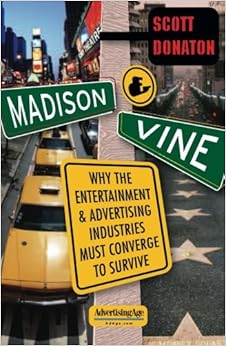
In the society we live in today, us human beings have become so accustomed to the many advertisements that are exposed to us. We become immune to whatever new technique a company may use in order to persuade us to buy something or to take action on something. So what have they done? In order to break through the clutter, many companies and organizations have resorted to the utilization of Madison & Vine.
Madison & Vine is a term that represents the merging of both advertisement and entertainment in order to break through the clutter of advertisements that we are exposed to on a daily basis. We are no longer as susceptible as we used to be when we are met with different types of advertisements. People may pay for things such as commercial-free television, or may purchase a premium subscription from networks in order to avoid advertisements. Consumers nowadays have the luxury of merely glazing over the large amounts of advertisements that we are subjected to. So, marketing professionals have resorted to the method of Madison & Vine. By integrating both entertainment and marketing, we may be more open to new products or ideas. Because we want to continue with whatever activity we're currently engaged in, we're forced to see things like product placements. We can't just tune out something that is put into our entertainment source like we do with commercials.
Personally, I don't really mind the use of Madison & Vine. I actually get a pretty good laugh out of it. Some product placements are pretty ridiculous. For example, let's say, there's a typical Korean drama with a family that's suffering from poverty. The parents are gone, and the dutiful daughter must work every single day non-stop, working whatever part-time jobs she can grab a hold of, in order to simply live and help support both her little sibling and herself. Then, for some reason, she pulls out this gigantic Samsung phone that's the latest edition. That totally makes sense, right? Not only that, but their phones are enclosed in a fancy case, and whenever someone messages someone, the camera always pans to the phone itself. They're usually using some sort of messaging app, like Kakao or LINE.
As another example, sports shoes are also pretty famous. Brands like Asics and Adidas are prominent in many dramas. Restaurant chains are also very popular choices for meetings between characters. American food chains have even started to make profit out of these dramas.
I like poking fun at product placements that are just so painfully obvious. Maybe a certain setting is used constantly (like coffee shops, where the drinks characters have are perfectly placed and untouched on the table), or the camera starts to zoom in on whatever product the characters are using. It's the best. (This is also why I miss Gag Concert's "King of Ratings", which I dedicated a blog post to.)
This lack of boundaries can both be effective and ineffective at the same time. On one hand, it's an effective marketing method in terms of adapting to the behaviors of the people in the society that we currently live in. No one wants to pay attention to a commercial we deem useless because we are preoccupied with our own affairs. It's the only way they can reach us. However, on the other hand, the effectiveness of Madison & Vine may decrease because we will begin to regard the product as illegitimate. How do we know if the things that we are told are actually true if it's intertwined with our sources of entertainment? Not only this, but we will become immune to this merging of entertainment and advertisements for consumers, and then people have to come up with new ways to break through the reinforced clutter. When that time comes, I'll be very interested in what other methods marketing professionals will come up with and use in order to break through the clutter.
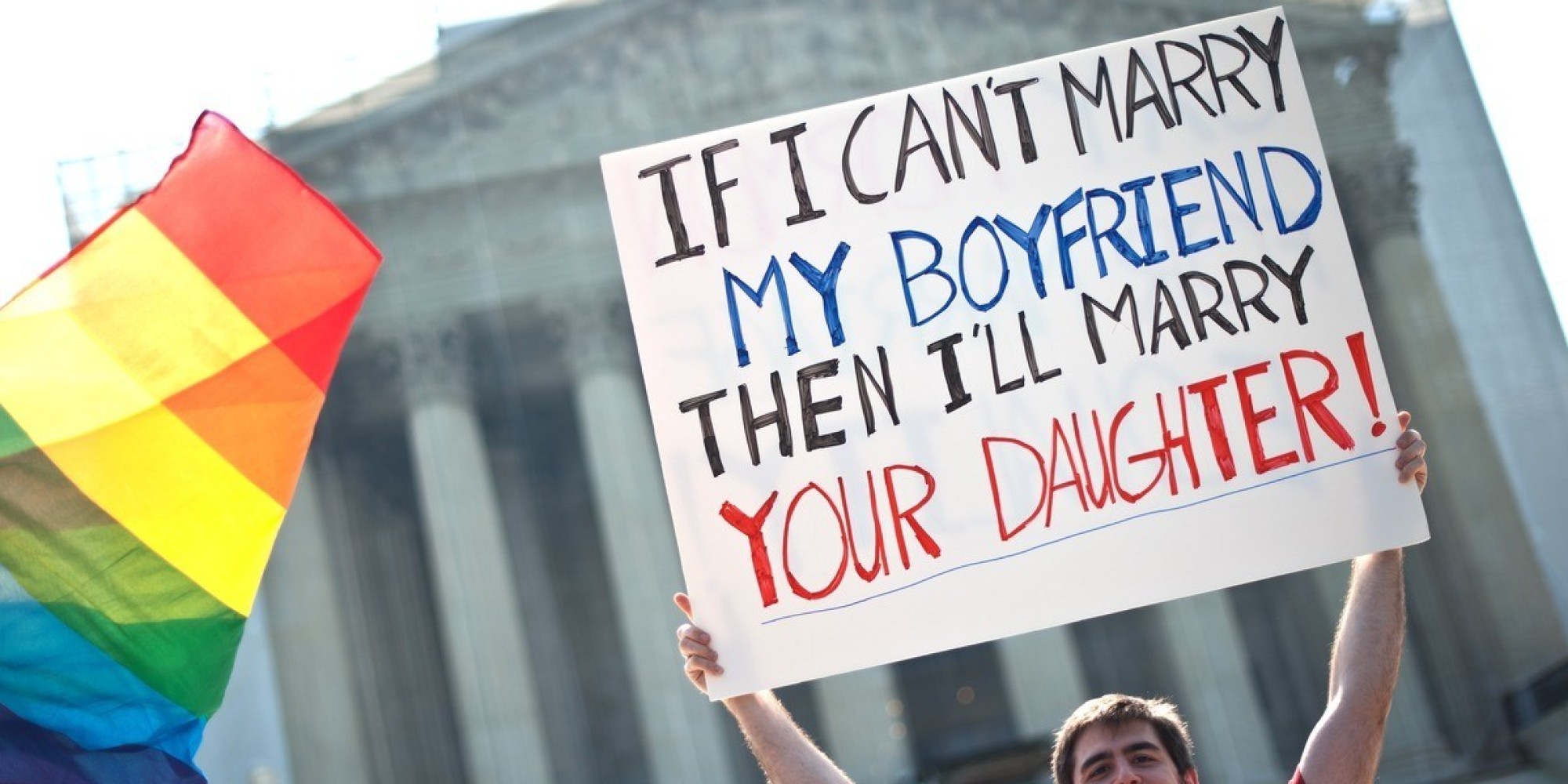
As I was browsing the Interwebs for a current topic to discuss, I came across the websites of several news outlets that all had at least an article on the topic of the gay marriage decision in the Supreme Court.
Different news sources, like the Washington Post or the New York Times, have articles about this. The first thing I noticed about these articles was the diction used. First, there's the use of the phrases "same-sex marriage" and "gay marriage". Since when did we become so sensitive that we had to create a euphemism for gay marriage? "Gay marriage" is great. It's simple and direct. It tells us what we need to know. However, our society has become so weak and sensitive that us humans don't want to face the truths of reality. Nowadays, "gay" holds a negative connotation for many of us. Its associations aren't positive. Many people view "gay" as an insult, and on the other hand, "same-sex" has more of a neutral connotation. This term doesn't hold weight to it even though both terms refer to the same thing. New York Times also uses "marriage equality" in one of its articles. "Marriage equality" is another euphemism for "gay marriage". This just shows that as we add more syllables to something, we are more comfortable using it. This is the power of language.
Washington Post uses a particular phrase in one of its articles: "Public attitudes...have undergone a remarkable change..." This is an example of what Orwell considers to be a "verbal false limb". The phrase mentioned above is inflated to seem more important than it actually is. It would be just as meaningful to say that the public attitudes have changed. The sentence was padded with extra words and syllables, even though a simple verb would have managed to deliver the meaning across to us. WP also uses the sentence "The acceptance is driven by higher margins among the young". Why does it have to be this complicated? Passive voice was also used in this sentence instead of active voice, which Orwell mentions as something that we prefer doing but should avoid doing. The authors of the article could have just written something as simple as "Many young people voted in favor of gay marriage".
The meanings of different phrases have been done away with, and it's completely sterile now. The reality that we can't seem to face is buried under extra words that don't mean anything. We add these extra syllables because we can't face the harsh reality that we live in. We need simple and direct language.
Ever since the beginning of my class discussion on the topic of advertisement, I've been wanting to write this post. "The King of Ratings" was the first thing that I thought of when my teacher mentioned product placements in media.
What is "The King of Ratings", you ask?
It's a gag segment from KBS World TV's Korean sketch-comedy show, Gag Concert, which is one of the oldest running comedy shows in South Korea. "The King of Ratings" is just but one of its popular skits. This skit is a parody of the satirical dramedy (combination of drama and comedy) The King of Dramas, which is about what goes on behind the scenes in the making of TV dramas.
"The King of Ratings" takes and exaggerates common methods used in the media to help gain popularity and help with advertising of, for example, a product. The comedians in this skit take things like typical soap-opera plot lines, idols actors, PPLs (product placements), and other cliches that, no matter how obvious and ridiculous they are, still bring in high viewer ratings.
In this particular episode of Gag Concert, "The King of Ratings" starts off as it normally does, with Director Park, played by Park Seonggwang, scolding one of his directors for bringing in low viewer ratings. Park names himself the "King of Ratings", and his main goal is to bring in the highest viewer ratings as possible no matter how they do it, even insisting on the awkward insertion of a PPL. This time, the setting is in a hospital, with the drama named "White Tower", which is similar to another real Korean drama, Behind the White Tower. (In each episode, this skit takes a drama name and puts a spin on it, which makes it more relatable to those who recognize the original, and as a result, more likely to continue watching this skit.) A patient comes in, who is diagnosed with a cold by the doctor. As the comedians act out "White Tower", Producer Park continuously complains about the viewer ratings. As the scene progresses, Park puts a twist on it, turning the patient's cold into something that will only allow him to live for three months.
These kinds of plot twists are so common in dramas nowadays in order to, for example, instigate conflict between certain characters or to extend a show that really should just be ended. Producers also may insert a scene where it acts as a catalyst for the protagonist to get what he/she wants. There's the typical "love interest gets hit by a car", for example. In this, the love interest is close to death, perhaps in a coma, which makes the other main character finally realize his/her true feelings. Or, there's the typical "main character gets amnesia" arc. The amnesia arc is very cliche in Korean dramas, and many people like to poke fun at it. It is put in to help move the plot along. These types of plot twists typically make viewer ratings go higher because the audience wants to know what's going to happen to the characters that they've grown so attached to.
They soon have to "operate" on the patient, but the doctor and intern who are residing over this patient end up being too nervous to operate to a comedic extent. They skip the operation scene because Producer Park wills it, and the patient is perfectly fine now. But, of course, we can't allow the viewer ratings to drop, can we? The patient suddenly is in an emergency state, and the doctors use a defibrillator.
The doctor says he wont give up on saving the patient, and he sits on him. Then, he suddenly get sick as well and falls on top of him. The intern, who is a comedian known for skits centering around her weight, tries to save the doctor, but then "falls" on top of the other two as well.
Producer Park later brings in another doctor: the good looking idol doctor, played by comedian Ryu Geun Ji. This is the typical idol star who is put in a drama despite his/her extremely bad acting. Even if those idols are completely horrible at acting, some directors and producers keep them to keep ratings up. Ratings shoot up, and Ryu purposefully acts out exaggerated bad acting. He recites the instructions, "Open parenthesis. Walk. Step. Step. Close parenthesis", which makes it all the more funnier, emphasizing the horrible acting of idol stars. (Of course, not all idol stars are horrible actors/actresses.) This brings up a strategy commonly used in real life. In order to profit, some may do whatever they can to achieve this, and will take advantage of someone or something. In this case, directors take advantage of the idol's popularity to gain higher viewer ratings in order to appeal to a large group of fans who would probably watch a whole drama just to see their bias. Fanatic fans wouldn't actually care if their bias's acting was bad--they probably would protect their bias to the ends of the earth. This is what directors feed off of in order to gain profit.
Everything's messed up now because of the idol doctor's horrible acting. Now what? Oh, okay, we'll just make this all a dream! (Producers might insert a plot twist like this in order to abruptly end a drama.) Then comes the absurd PPL.
Of course, real PPLs aren't like this in the movies and shows we watch today. (At least I haven't noticed any this painfully obvious.) In this skit, everything is exaggerated, and it lets us have a good laugh about it. But a lot of the time, we see many products being used by a character, or a product lovemark in the background somewhere. What exactly are they trying to tell us? "Go to this place and buy this stuff because you see your favorite characters trying these things out, and they're so happy with it, so you will be as well!"
"The King of Ratings" makes fun of all of the elements used by producers in their dramas. Each part is exaggerated, from colds being a deadly illness to a hiking boot in a stomach during an operation, which makes it even better to watch. This exaggerated, comedic style not only parodies those elements used, but it also makes us stay and continue watching, because these absurd aspects stand out to us and we want to know everything that comes next.
I definitely would recommend this (actually, I would probably recommend most of the Gag Concert skits). I think they're all very entertaining, and it definitely makes me laugh. The ideas that the comedians come up with are just pure gold (of course, I'm probably just completely biased). Of course, a handful of the jokes that the comedians come up with are definitely jokes that would only make sense if you were born in Korea and were used to their culture (it probably would help if you actually knew the language as well). But I believe that many of the skits would be appealing to many of us. Or, I'm just so used to their sense of humor that I'm the only one that thinks this is funny.