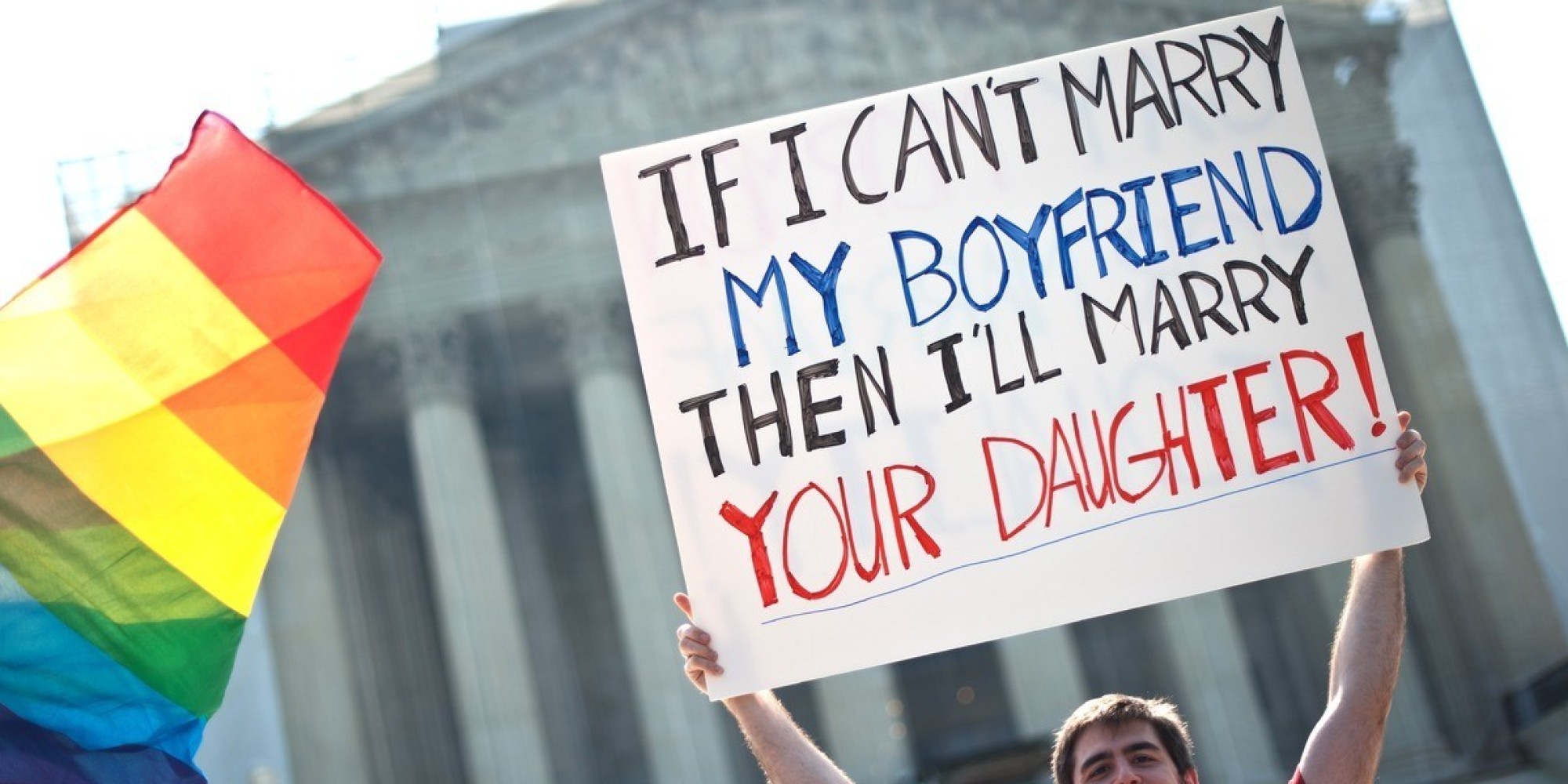
Different news sources, like the Washington Post or the New York Times, have articles about this. The first thing I noticed about these articles was the diction used. First, there's the use of the phrases "same-sex marriage" and "gay marriage". Since when did we become so sensitive that we had to create a euphemism for gay marriage? "Gay marriage" is great. It's simple and direct. It tells us what we need to know. However, our society has become so weak and sensitive that us humans don't want to face the truths of reality. Nowadays, "gay" holds a negative connotation for many of us. Its associations aren't positive. Many people view "gay" as an insult, and on the other hand, "same-sex" has more of a neutral connotation. This term doesn't hold weight to it even though both terms refer to the same thing. New York Times also uses "marriage equality" in one of its articles. "Marriage equality" is another euphemism for "gay marriage". This just shows that as we add more syllables to something, we are more comfortable using it. This is the power of language.
Washington Post uses a particular phrase in one of its articles: "Public attitudes...have undergone a remarkable change..." This is an example of what Orwell considers to be a "verbal false limb". The phrase mentioned above is inflated to seem more important than it actually is. It would be just as meaningful to say that the public attitudes have changed. The sentence was padded with extra words and syllables, even though a simple verb would have managed to deliver the meaning across to us. WP also uses the sentence "The acceptance is driven by higher margins among the young". Why does it have to be this complicated? Passive voice was also used in this sentence instead of active voice, which Orwell mentions as something that we prefer doing but should avoid doing. The authors of the article could have just written something as simple as "Many young people voted in favor of gay marriage".
The meanings of different phrases have been done away with, and it's completely sterile now. The reality that we can't seem to face is buried under extra words that don't mean anything. We add these extra syllables because we can't face the harsh reality that we live in. We need simple and direct language.


No comments:
Post a Comment