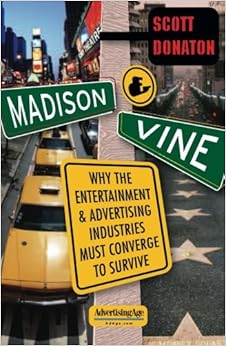
In the society we live in today, us human beings have become so accustomed to the many advertisements that are exposed to us. We become immune to whatever new technique a company may use in order to persuade us to buy something or to take action on something. So what have they done? In order to break through the clutter, many companies and organizations have resorted to the utilization of Madison & Vine.
Madison & Vine is a term that represents the merging of both advertisement and entertainment in order to break through the clutter of advertisements that we are exposed to on a daily basis. We are no longer as susceptible as we used to be when we are met with different types of advertisements. People may pay for things such as commercial-free television, or may purchase a premium subscription from networks in order to avoid advertisements. Consumers nowadays have the luxury of merely glazing over the large amounts of advertisements that we are subjected to. So, marketing professionals have resorted to the method of Madison & Vine. By integrating both entertainment and marketing, we may be more open to new products or ideas. Because we want to continue with whatever activity we're currently engaged in, we're forced to see things like product placements. We can't just tune out something that is put into our entertainment source like we do with commercials.
Personally, I don't really mind the use of Madison & Vine. I actually get a pretty good laugh out of it. Some product placements are pretty ridiculous. For example, let's say, there's a typical Korean drama with a family that's suffering from poverty. The parents are gone, and the dutiful daughter must work every single day non-stop, working whatever part-time jobs she can grab a hold of, in order to simply live and help support both her little sibling and herself. Then, for some reason, she pulls out this gigantic Samsung phone that's the latest edition. That totally makes sense, right? Not only that, but their phones are enclosed in a fancy case, and whenever someone messages someone, the camera always pans to the phone itself. They're usually using some sort of messaging app, like Kakao or LINE.


As another example, sports shoes are also pretty famous. Brands like Asics and Adidas are prominent in many dramas. Restaurant chains are also very popular choices for meetings between characters. American food chains have even started to make profit out of these dramas.


I like poking fun at product placements that are just so painfully obvious. Maybe a certain setting is used constantly (like coffee shops, where the drinks characters have are perfectly placed and untouched on the table), or the camera starts to zoom in on whatever product the characters are using. It's the best. (This is also why I miss Gag Concert's "King of Ratings", which I dedicated a blog post to.)

This lack of boundaries can both be effective and ineffective at the same time. On one hand, it's an effective marketing method in terms of adapting to the behaviors of the people in the society that we currently live in. No one wants to pay attention to a commercial we deem useless because we are preoccupied with our own affairs. It's the only way they can reach us. However, on the other hand, the effectiveness of Madison & Vine may decrease because we will begin to regard the product as illegitimate. How do we know if the things that we are told are actually true if it's intertwined with our sources of entertainment? Not only this, but we will become immune to this merging of entertainment and advertisements for consumers, and then people have to come up with new ways to break through the reinforced clutter. When that time comes, I'll be very interested in what other methods marketing professionals will come up with and use in order to break through the clutter.

No comments:
Post a Comment